
Why Nations Fail: The Origins of Power, Prosperity, and Poverty
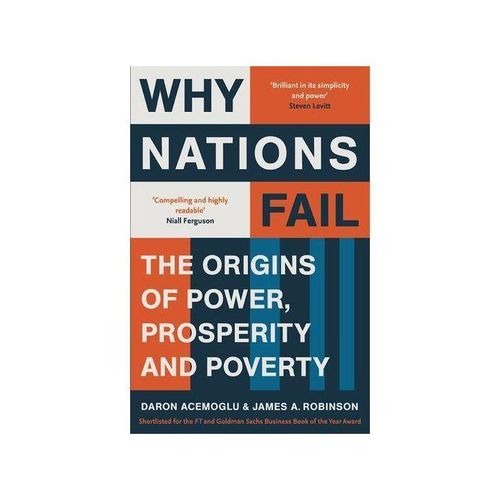
Authors: Daron Acemoglu and James A. Robinson
Top Idea: Nations achieve sustained prosperity when political power is sufficiently constrained and widely distributed to support economic institutions that protect rights, encourage innovation, and allow broad participation. They struggle when institutions concentrate power and economic opportunities among groups with incentives to preserve their privileges, even at the expense of wider development.
The Big Idea
Why do some countries become prosperous while others remain poor? Why do societies with comparable geographical conditions, cultural backgrounds, and human capabilities experience markedly different economic outcomes?
In Why Nations Fail, Daron Acemoglu and James A. Robinson offer an ambitious answer. The principal explanation lies in the political and economic institutions that societies establish, the incentives those institutions create, and the distribution of power that sustains them.
Their argument begins with an important distinction between inclusive and extractive institutions.
Inclusive economic institutions protect property rights, uphold the rule of law, provide public services, encourage investment, and create opportunities for individuals to participate in productive activity. Extractive economic institutions, by contrast, organise economic activity in ways that disproportionately benefit those controlling political and economic power, often restricting competition, innovation, and opportunity.
These arrangements are sustained by political institutions. Inclusive political institutions combine a sufficiently centralised state with political pluralism and constraints on the arbitrary exercise of authority. Extractive political institutions concentrate power among narrow groups capable of shaping economic rules to preserve their positions.
The authors argue that these political and economic arrangements reinforce one another. Concentrated political power makes it easier to establish institutions that distribute resources towards powerful groups. The economic advantages generated by those institutions subsequently provide additional resources for maintaining political control.
Conversely, institutions that distribute political power, constrain arbitrary authority, and encourage broad economic participation can create conditions under which innovation and prosperity become more sustainable.
The book is not, however, a simple argument that extractive societies can never grow. Acemoglu and Robinson acknowledge that substantial economic expansion can occur under extractive institutions, particularly when governments mobilise resources towards productive activities or adopt existing technologies.
Their contention is that such growth becomes difficult to sustain when further progress requires innovation, competition, and economic changes that threaten established political interests.
Drawing on cases ranging from the Roman Empire and colonial Latin America to Britain, Botswana, the Soviet Union, and the Korean peninsula, the authors demonstrate how institutions emerge, persist, and occasionally change.
Ultimately, Why Nations Fail argues that poverty is not simply a consequence of insufficient resources, unfavourable geography, or poor economic knowledge. It is frequently sustained by political arrangements that make the preservation of concentrated power more rewarding to influential groups than the creation of broad-based prosperity.
Top Lessons
1. Institutions determine how economic opportunities are distributed.
One of the book’s most useful distinctions is between the resources available to a society and the institutional conditions governing their productive use.
Individuals are more likely to invest, acquire skills, establish enterprises, and develop new technologies when they can reasonably expect their efforts to produce returns that will not be arbitrarily confiscated.
This requires more than formal recognition of property rights. It requires functioning legal institutions, reliable public services, access to markets, and rules that do not systematically favour politically connected participants.
The authors illustrate this argument through the contrast between Nogales, Arizona, and Nogales, Sonora.
Separated by an international border, the two communities share important geographical and cultural characteristics but operate under different national political and economic institutions.
For Acemoglu and Robinson, their contrasting experiences demonstrate why explanations based solely on geography or culture cannot adequately account for economic disparities.
The broader lesson is that productive capabilities do not develop independently of the rules governing economic participation.
2. Political institutions shape the economic institutions a society can sustain.
Acemoglu and Robinson place political power at the centre of economic development.
A society may recognise the benefits of competition, innovation, and secure property rights while still maintaining institutions that undermine them.
This is because economic rules are not selected exclusively for their contribution to national prosperity. They emerge from political processes involving groups with different interests and unequal influence.
Inclusive political institutions constrain the arbitrary exercise of authority and permit broader participation in decisions.
Crucially, the authors argue that inclusion also requires sufficient political centralisation to enforce laws, maintain order, and provide public goods.
This is an important qualification. Political pluralism without an effective state may leave economic rights inadequately protected, while a powerful state without meaningful constraints may facilitate arbitrary extraction.
The developmental challenge is therefore not simply to build a stronger government or expand political participation in isolation. It is to establish institutions in which public authority is both effective and constrained.
3. Economic progress threatens established interests.
The authors draw on Joseph Schumpeter’s concept of creative destruction to explain why political and economic elites may oppose changes that would increase national prosperity.
Innovation creates new industries and economic opportunities, but it also displaces established businesses, technologies, skills, and sources of influence.
For groups whose political authority depends on controlling existing economic arrangements, technological progress may represent a threat rather than an opportunity.
This helps explain why governments sometimes preserve monopolies, restrict competition, resist technological change, or maintain policies that protect established interests.
Such opposition is not necessarily a misunderstanding of economic benefits.
An arrangement may be harmful to the wider economy while remaining highly beneficial to those capable of preserving it.
The resulting conflict between collective prosperity and concentrated advantage is central to the book’s explanation of persistent underdevelopment.
4. Economic growth can occur without inclusive institutions, but its sustainability is contested.
The experiences of the Soviet Union and China occupy an important place in the authors’ argument.
Acemoglu and Robinson acknowledge that centralised political systems can generate substantial economic growth through resource mobilisation, industrial expansion, and the adoption of existing technologies.
The Soviet Union achieved considerable industrial growth despite its extractive political institutions.
China’s economic expansion following market-oriented reforms also demonstrated that important changes in economic incentives can occur without a corresponding transition to political pluralism.
Writing in 2012, the authors argued that China’s long-term growth would face constraints unless its political institutions evolved to accommodate the innovation and creative destruction required for sustained development.
The lesson is that economic expansion should not automatically be interpreted as evidence of institutional inclusiveness.
However, this argument also creates an important analytical responsibility. The distinction between temporary growth and sustainable growth must be specified carefully enough to be tested against subsequent economic performance.
5. Historical turning points can alter institutional trajectories.
The book does not treat contemporary institutions as inevitable consequences of ancient history.
Instead, the authors develop the concepts of institutional drift and critical junctures.
Small differences in political and economic arrangements may persist for long periods without producing dramatically different outcomes. Major historical disruptions can then amplify those differences and redirect the development of entire societies.
The Black Death provides one example.
Acemoglu and Robinson examine how the demographic shock contributed to different institutional developments in Western and Eastern Europe, with labour scarcity interacting with existing political arrangements in ways that weakened some forms of coercion while strengthening others.
The Glorious Revolution of 1688 provides another example.
In the authors’ interpretation, changes in the distribution and constraint of political power in England contributed to institutional arrangements that eventually supported the Industrial Revolution.
These cases demonstrate how the consequences of historical shocks depend partly on the institutions already in place.
They also explain why similar external events need not produce identical developmental outcomes.
6. Inclusive and extractive institutions can become self-reinforcing.
One of the book’s strongest concepts is the distinction between virtuous and vicious institutional circles.
Inclusive arrangements can create constituencies that defend political rights, protect competition, and resist the arbitrary concentration of power.
These processes can help sustain further inclusion.
Extractive institutions operate through a different feedback mechanism.
Political leaders and economic groups benefiting from privileged arrangements accumulate the resources required to preserve those arrangements.
Those seeking political office may consequently become more interested in gaining control over existing benefits than in changing the institutions that produce them.
This helps explain why replacing political leaders does not necessarily transform political systems.
A change in leadership can reproduce the same incentives if the underlying distribution of power and institutional constraints remains substantially unchanged.
Yet the authors also insist that institutional arrangements are not immutable. Historical contingency, collective action, and changes in political coalitions can create opportunities for transformation.
My Notes
Institutions matter, but what exactly counts as an institution?
The central argument of Why Nations Fail is persuasive because it directs attention towards the rules governing economic and political behaviour.
There is considerable analytical value in asking whether individuals can enforce contracts, enter markets, acquire assets, challenge arbitrary decisions, or hold public authorities accountable.
These are more precise questions than simply asking whether a country has good governance.
Nevertheless, I find the distinction between inclusive and extractive institutions more useful as an organising framework than as a complete explanation of economic performance.
The categories are exceptionally broad.
A country may have relatively secure property rights while maintaining substantial barriers to political participation. It may possess competitive elections but weak courts, unreliable public administration, and severe inequalities in access to economic opportunities.
Another country may have extensive political restrictions while permitting considerable entrepreneurial activity and market competition.
These differences matter.
When institutions are classified mainly through their relationship with observed prosperity, the argument risks becoming circular. Successful societies are described as inclusive because their institutions are associated with success, while unsuccessful societies are described as extractive because their institutions are associated with failure.
To avoid this problem, institutional characteristics must be defined and measured independently of economic outcomes.
The stronger research question is not simply whether inclusive institutions generate prosperity. It is which specific institutional arrangements influence which economic outcomes, through what mechanisms, and under what conditions.
This would allow the authors’ propositions to be examined rather than merely illustrated.
The importance of political centralisation and pluralism
One feature of the book that deserves more attention is the relationship between state capacity and political inclusion.
Acemoglu and Robinson do not argue that prosperity emerges from an absence of government.
Their framework recognises the importance of a centralised political authority capable of maintaining order, enforcing rules, and providing public goods.
At the same time, that authority must face sufficient constraints to prevent its concentration of power from becoming an instrument of extraction.
This creates an important institutional tension.
A government may possess substantial coercive capacity without being administratively effective. Another may have competitive political institutions without possessing the practical capability to implement economic policy.
The existence of elections does not establish that property rights are secure, public contracts are enforceable, or government services are reliable.
Likewise, strong executive authority does not necessarily translate into effective service delivery.
I therefore find it useful to distinguish political inclusion, political centralisation, bureaucratic capability, and administrative accountability.
They interact, but they are not interchangeable.
A more complete understanding of development requires examining how these different characteristics are combined within particular institutions.
Creative destruction provides an explanation for resistance to reform.
The book’s treatment of creative destruction is among its most convincing contributions.
Economic development is frequently discussed as though productive improvements necessarily benefit all members of society in the same way.
In reality, new technologies, greater competition, changes in trade arrangements, and the emergence of new industries redistribute economic opportunities.
Some enterprises expand while others contract. New occupations emerge while existing skills lose value. Previously influential economic groups may find their market positions threatened.
These changes can also alter political relationships.
An incumbent business benefiting from privileged access to public contracts, import restrictions, or regulatory protection may oppose reforms that expose it to competition.
Such opposition can be economically rational from the incumbent’s perspective even when the proposed reform promises wider benefits.
The distinction between private incentives and collective outcomes is fundamental.
However, I would extend the analysis by distinguishing opposition arising from entrenched privilege from opposition arising from genuine transitional hardship.
Workers displaced by technological change and households facing the immediate costs of reform do not necessarily occupy the same position as powerful firms protecting monopolistic advantages.
Both groups may oppose economic restructuring, but the institutional responses required are different.
Protecting economic dynamism may require dismantling privileged arrangements while also providing credible mechanisms through which displaced workers and vulnerable households can adjust.
The politics of creative destruction therefore concerns not only who can prevent change, but also how societies distribute its costs and benefits.
Does the institutional explanation give enough attention to geography and history?
The authors challenge geographical, cultural, and ignorance-based explanations of global inequality.
Their argument is especially compelling where societies with similar environmental and cultural characteristics follow sharply different institutional trajectories.
The Korean peninsula is an important illustration. Shared historical and cultural foundations did not prevent North and South Korea from developing radically different political and economic systems.
Nevertheless, demonstrating that geography cannot explain every development outcome does not establish that geography is irrelevant.
Location, climate, disease environments, resource endowments, transport costs, and access to trade routes may influence development directly and through the institutions that emerge in response to them.
Similarly, the intellectual traditions, social arrangements, and historical experiences of particular societies may shape political organisation without making cultural characteristics permanent determinants of prosperity.
The relevant question is not necessarily whether institutions or geography matter more in every setting.
It is how these factors interact, which mechanisms dominate under particular conditions, and what evidence supports their relative contributions.
The authors’ broad institutional argument would become more persuasive if it engaged more extensively with these relationships instead of placing competing explanations in such sharp opposition.
The problem of historical selectivity
The book draws on an extraordinary range of historical cases.
Its geographical and chronological scope is intellectually stimulating, but it also creates methodological difficulties.
Historical narratives can demonstrate that a proposed mechanism is plausible without necessarily establishing that it was the decisive cause of an outcome.
The British experience illustrates this problem.
Acemoglu and Robinson emphasise institutional changes associated with the Glorious Revolution and their eventual contribution to industrialisation.
This is a compelling account of how constraints on political authority and changes in economic incentives may have encouraged investment and innovation.
Yet Britain’s economic expansion also occurred alongside overseas empire, colonial extraction, slavery, unequal political representation, and substantial restrictions on domestic participation.
These features complicate a simple interpretation of Britain as an increasingly inclusive society.
The book does acknowledge the destructive consequences of European colonialism and the institutional arrangements imposed on colonised societies. Nevertheless, its broader framework leaves questions about how increasing inclusion within an imperial centre could coexist with extraction elsewhere.
A political economy of global development must consider these relationships.
The prosperity of one society may not always be adequately explained through its domestic institutions without examining the international economic and political arrangements in which those institutions operated.
The same caution applies to other historical cases.
Institutional change should be examined alongside trade, technology, coercion, geography, and the distribution of resources rather than presented as a self-contained explanation.
Why transitions are harder to explain than institutional persistence
The book offers a convincing explanation of why extractive institutions can survive repeated changes in political leadership.
Those who gain control over concentrated political power may inherit the same incentives that shaped their predecessors.
The resources available through political office make control of the state valuable, while weak institutional constraints make the preservation of privileged arrangements relatively attractive.
This helps explain why political transitions do not automatically produce institutional transformation.
However, explaining persistence is not the same as explaining successful change.
If powerful groups benefit from existing institutions, what creates incentives for them to accept constraints on their own authority?
The authors emphasise historical contingency, critical junctures, and the mobilisation of broad political coalitions.
These are important elements, but they leave substantial questions unresolved.
Under what conditions can broad coalitions become sufficiently organised to change institutions? Which reforms can be introduced before a wider transformation in political power? How can credible commitments to inclusion be established when competing groups distrust one another?
The absence of precise answers is understandable given the historical complexity of the subject.
Nevertheless, it limits the book’s value as a practical guide to institutional reform.
The diagnosis is considerably more developed than the programme for achieving change.
What the book added to my understanding
The most important lesson I take from Why Nations Fail is a more precise appreciation of how political and economic institutions reinforce one another.
It is insufficient to examine an economic policy solely through its stated objectives or anticipated efficiency gains.
The relevant institutional environment determines who can participate, who can enforce their rights, who benefits from implementation, and whether those benefiting from existing arrangements can obstruct change.
This shifts attention from the formal existence of rules to the distribution of power through which those rules are created and enforced.
The book also sharpens my understanding of institutional persistence.
An ineffective arrangement may endure not because its consequences are poorly understood, but because influential participants receive sufficiently large benefits from its continuation.
Consequently, greater technical knowledge alone may not remove the obstacles to reform.
At the same time, the limitations of the authors’ framework encourage an additional distinction. Institutions must be studied at the level of specific mechanisms, not simply classified through broad national labels.
The security of land rights, independence of regulatory authorities, reliability of public finance systems, enforcement of contracts, administrative coordination, and openness of market entry may influence economic behaviour through different channels.
Their effects require separate investigation.
Finally, the book strengthens my understanding of development as a historical process.
Institutions evolve through political conflict, social mobilisation, economic pressure, and contingent events. Their current characteristics reflect earlier decisions, but those characteristics can change.
The enduring question is therefore not simply why some countries possess more inclusive institutions than others.
It is how particular distributions of power become embedded in economic rules, how those arrangements influence behaviour, and what conditions make them susceptible to reform.
That is the analytical perspective I would carry forward.
Key Takeaways for the Nigerian Condition
1. The quality of institutions must be assessed through their actual operation.
Nigeria’s institutional development cannot be adequately assessed through the existence of constitutions, legislation, regulatory agencies, or public programmes alone.
The relevant questions concern how those institutions function.
Can individuals enforce contracts without excessive delay? Can enterprises enter markets without arbitrary restrictions? Are administrative decisions predictable? Are property rights secure? Can citizens and businesses challenge the misuse of public authority?
These are practical indicators of the institutional conditions that shape economic opportunity.
The distinction between formal rules and their implementation should therefore be central to assessing governance and economic reform.
2. Political incentives must be incorporated into economic policy design.
Nigeria’s development strategies frequently involve decisions about taxation, public expenditure, industrial support, infrastructure, market regulation, and the distribution of public resources.
Each intervention affects groups with different economic and political interests.
An institutional analysis should therefore ask which groups support a reform, which groups oppose it, and whether existing arrangements give particular actors the capacity to influence its implementation.
This does not mean reducing every policy outcome to elite self-interest.
It means recognising that political incentives are part of the environment in which economic decisions are made.
Understanding those incentives can help distinguish technically desirable reforms from reforms that possess credible implementation arrangements.
3. Administrative capacity and political accountability should develop together.
Economic development requires institutions capable of performing identifiable public functions.
These include revenue administration, infrastructure maintenance, dispute resolution, market oversight, public financial management, and the delivery of essential services.
However, expanding government capability without effective accountability may increase the resources available for arbitrary decision-making.
Conversely, formal political accountability without administrative capability may produce institutions that are representative but unable to deliver their responsibilities effectively.
The objective should therefore be to examine how state capability and institutional constraints can reinforce one another.
4. Market access and competition deserve greater attention.
The framework presented in Why Nations Fail has direct implications for the organisation of markets.
An enterprise’s prospects depend not only on entrepreneurial ability or access to finance, but also on the legal and institutional environment governing entry, competition, contracts, and investment.
Policies that systematically favour selected participants may discourage innovation and restrict the development of new enterprises.
However, the presence of a large firm or industrial concentration should not automatically be treated as evidence of extraction.
The appropriate assessment concerns how market advantages are created, whether competition remains possible, and whether public interventions generate demonstrable productive benefits.
Nigeria’s industrial and enterprise policies should be evaluated against these distinctions.
5. Subnational institutional differences should be investigated rather than assumed away.
Nigeria’s states operate within a shared constitutional framework but differ in administrative arrangements, economic structures, public service capabilities, and political conditions.
These differences create opportunities for comparative analysis.
It is possible to investigate whether variation in the enforcement of commercial rules, land administration, revenue systems, public procurement, or infrastructure management is associated with different investment and productivity outcomes.
However, such comparisons must also account for differences in geography, population, inherited infrastructure, market size, and economic history.
Institutional explanations should be tested against competing explanations rather than inferred automatically from observed differences in state performance.
6. Agricultural development requires institutions that support market participation.
The institutional perspective is particularly relevant to food systems.
Farmers, traders, processors, transporters, and consumers interact through arrangements governing access to land, markets, finance, infrastructure, information, and contract enforcement.
Weaknesses in these arrangements can influence transaction costs, investment decisions, production incentives, and the reliability of food distribution.
For example, secure and enforceable commercial arrangements may encourage investment in storage and processing, while uncertain rules or privileged market access may discourage potential competitors.
Yet the book’s argument should not be stretched into the claim that every food-security problem is primarily institutional.
Weather shocks, biological conditions, infrastructure constraints, and household purchasing power also matter.
The more useful application is to investigate when institutional arrangements amplify or reduce the consequences of such constraints.
7. Institutional reform should be measured through identifiable outcomes.
The distinction between inclusive and extractive institutions becomes most useful when translated into observable questions.
For instance, an assessment of a reform could examine whether market-entry barriers declined, contract enforcement improved, regulatory decisions became more predictable, or access to public services expanded.
It should then investigate whether those changes produced measurable improvements in investment, productivity, employment, or welfare.
This creates a necessary separation between institutional reform as an activity and economic development as an outcome.
The introduction of a reform is not itself proof that the reform worked.
8. Political transitions do not automatically produce institutional transformation.
Changes in leadership may create opportunities to revise policies or institutional arrangements.
However, the incentives associated with concentrated authority can survive those changes.
The authors’ discussion of institutional persistence suggests that durable reform requires more than replacing the individuals controlling public institutions.
It also requires attention to the rules governing authority, the distribution of economic opportunities, and the mechanisms through which decisions are scrutinised.
For Nigeria, the implication is analytical rather than partisan. Meaningful institutional progress should be evaluated through observable changes in rules, incentives, accountability, and performance, not merely through changes in political officeholders.
Notable Quotes
- We have to look at institutions for an answer.
- Nations fail economically because of extractive institutions.
My Final Assessment
Why Nations Fail is an ambitious and intellectually consequential examination of the institutional foundations of economic development.
Its greatest contribution lies in showing how political arrangements shape economic incentives and why groups benefiting from established institutions may resist changes that would improve broader economic performance.
The distinction between inclusive and extractive institutions is a useful starting point for understanding persistent inequality, restricted economic opportunity, and the political obstacles facing structural transformation.
The book is particularly persuasive in its treatment of institutional persistence, political power, and creative destruction.
However, its ambition also exposes its limitations.
The inclusive–extractive distinction sometimes encompasses institutions that differ considerably in their operation and consequences. The extensive historical narratives do not always establish that institutional arrangements were the decisive cause of the outcomes described. Geography, technology, imperial relationships, and other historical forces may interact with institutions more extensively than the framework permits.
The book also explains why institutions persist more convincingly than it explains how societies can deliberately transform them.
These reservations are important, but they do not diminish the usefulness of its central analytical contribution.
For students of political economy, public administrators, researchers, and readers concerned with development, the book provides a compelling reason to examine the relationship between political authority, economic rules, and the distribution of opportunity.
The most important conclusion I take from it is that economic development cannot be understood solely through resources, policies, or the technical capacity to produce. It must also be understood through the institutions that determine who can exercise power, who can participate in economic activity, and whether those arrangements encourage innovation or preserve concentrated advantage.
That is the value of Why Nations Fail. It makes the political foundations of economic prosperity impossible to ignore, while leaving important questions about institutional measurement, historical causation, and the practical conditions for reform open to further investigation.
Keep the conversation open.
Essays, reading notes and public commentary on food, households, markets, institutions, public service and leadership.
Subscribe to receive new essaysExplore more writing