
Civil Service and the Imperative of Nation Building
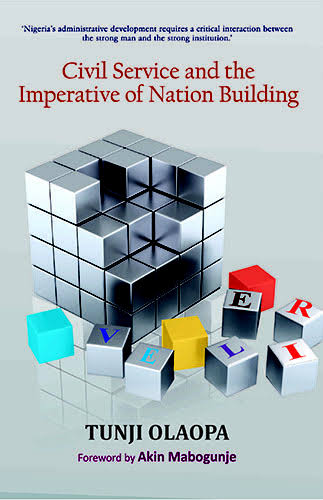
Author: Tunji Olaopa
Top Idea: The Nigerian civil service is more than an administrative instrument for implementing government policies. It is also an institution through which citizens experience the authority, fairness and competence of the state. Its ability to contribute to nation building therefore depends on the quality of public administration and the confidence that Nigerians can place in institutions intended to serve them collectively.
The Big Idea
Nigeria’s challenge of nation building is frequently discussed through ethnicity, religion, political representation, constitutional arrangements and the distribution of public resources.
These issues are undoubtedly important. However, they do not fully explain how citizens develop confidence in the state or come to regard national institutions as legitimate.
In Civil Service and the Imperative of Nation Building, Tunji Olaopa directs attention towards an institution that is often treated as secondary in discussions about national unity: the civil service.
His central proposition is that the Nigerian civil service occupies an important position between the government’s developmental responsibilities and the broader task of sustaining a shared national identity.
The civil service provides administrative continuity, supports the implementation of public policy and helps translate the authority of government into services and institutional decisions that affect citizens.
Its responsibilities extend beyond the internal management of ministries and departments. Through the quality of administration, the state demonstrates whether its institutions can act competently, fairly and consistently in the interests of the population.
Olaopa approaches this question through the historical development of Nigeria’s civil service, its institutional weaknesses, previous reform efforts and the possibilities for administrative renewal.
The book examines the relationship between leadership and institutional development, governance and administrative reform, the place of the civil service in national development, and the challenge of open government.
These concerns reflect Olaopa’s broader conviction that effective public administration is indispensable to a functioning state.
However, this book adds a distinctive national dimension to that argument.
In a society characterised by substantial ethnic, religious and regional diversity, the performance of public institutions can influence whether citizens experience government as a common institution or as an instrument controlled primarily for the benefit of particular groups.
An administrative system that applies rules consistently, delivers public services competently and provides opportunities for legitimate participation may contribute to confidence in common institutions.
Conversely, persistent administrative failure, arbitrary decisions and unequal treatment can undermine that confidence.
The significance of this argument lies in the relationship it establishes between public administration and political legitimacy.
Olaopa does not simply present civil service reform as an exercise in managerial efficiency. He connects the reform of administrative institutions with the larger question of how Nigeria can consolidate its existence as a functioning national community.
The civil service cannot independently resolve every conflict concerning Nigerian nationhood. Political leadership, constitutional arrangements, economic opportunities and wider social relationships remain important.
Nevertheless, Olaopa’s central insight is that the daily functioning of government institutions can strengthen or weaken the foundations upon which national cohesion depends.
Nation building, from this perspective, is not achieved through expressions of national loyalty alone. It also requires institutions through which citizenship acquires practical meaning.
Top Lessons
1. Nation building depends partly on citizens’ experiences of public institutions.
National unity is often discussed as a matter of shared identity, patriotic commitment and mutual recognition among different communities.
Olaopa’s argument introduces another dimension.
Citizens also encounter the state through its administrative institutions.
They apply for documents, seek official approvals, access public services, comply with regulations and interact with agencies exercising public authority.
These experiences can influence how they understand the character of government.
Where institutions operate predictably and fairly, they may strengthen confidence in the state’s ability to serve the public.
Where decisions appear arbitrary, access to services is unequal or administrative procedures become excessively burdensome, public confidence may weaken.
The lesson is that national legitimacy possesses an administrative dimension.
A government cannot rely indefinitely on appeals to national loyalty while neglecting the institutional responsibilities through which citizens encounter its authority.
2. Administrative effectiveness and national integration are connected but distinct.
The book establishes a relationship between service delivery and the development of a stronger national community.
This is an important proposition, but it requires careful interpretation.
Administrative effectiveness concerns whether public institutions perform their responsibilities competently and reliably.
National integration concerns the development of relationships, institutions and shared commitments through which different communities participate in a common political order.
These are not identical outcomes.
An efficient institution may still apply rules unfairly. A representative institution may still lack the resources or competence required to deliver services.
The more convincing interpretation of Olaopa’s argument is that administrative effectiveness contributes to national integration when it is accompanied by fairness, accountability and sufficiently broad access to public institutions.
The objective should therefore be more than an efficient bureaucracy.
It should be a capable public administration whose performance can sustain confidence among the communities it serves.
3. The history of the civil service matters for understanding its present condition.
Olaopa treats Nigeria’s administrative history as relevant to the possibilities for future reform.
The civil service inherited from colonial rule underwent substantial changes during independence, military government and subsequent democratic administrations.
These transitions affected the distribution of administrative authority, professional relationships, personnel arrangements and the role of senior civil servants in government.
The historical experience is important because institutions retain practices, incentives and organisational characteristics developed under earlier political arrangements.
Some traditions may support professional competence and continuity. Others may restrict accountability, discourage innovation or preserve inappropriate concentrations of authority.
Understanding this inheritance is therefore necessary for identifying what should be preserved, modified or abandoned.
However, historical experience must be examined without assuming that an earlier administrative era was uniformly effective or inclusive.
The appropriate lesson is that meaningful reform requires institutional memory and critical historical understanding, not nostalgia.
4. Professionalism is essential to public trust.
The civil service performs functions that require technical competence, ethical judgement, confidentiality, impartiality and a commitment to the lawful exercise of public authority.
These professional obligations help distinguish career administration from political competition.
Public officials are expected to carry out legitimate government decisions while observing established rules and maintaining the continuity of institutions.
Olaopa’s emphasis on professional administration is relevant because citizens need confidence that official decisions are not determined entirely by personal relationships or political influence.
Yet professionalism cannot be sustained through moral exhortation alone.
Recruitment procedures, career progression, training, management practices and disciplinary systems influence how officials behave.
A professional civil service consequently requires institutional arrangements that support competence and integrity.
Its contribution to national development depends on these arrangements being effective in practice.
5. Political leadership and administrative leadership must reinforce one another.
The relationship between politicians and career administrators is central to government performance.
Political leaders possess authority to determine policy priorities within the constitutional framework.
Civil servants provide technical advice, administrative continuity and the organisational capabilities needed for implementation.
These responsibilities are different but connected.
A technically capable civil service may struggle when political priorities are inconsistent or when officials lack the authority and resources required to implement decisions.
Similarly, a government with clear political priorities may produce disappointing results where administrative institutions lack the competence or organisation needed to act.
The lesson is that neither political commitment nor bureaucratic expertise is sufficient independently.
Effective public administration requires a working relationship in which legitimate political direction is supported by professional advice, clear responsibilities and institutional accountability.
6. Open government is part of the challenge of administrative legitimacy.
The book’s attention to open government broadens the discussion beyond internal civil service performance.
Public institutions must not only carry out their responsibilities. They must also operate within arrangements that allow their decisions to be examined and challenged where necessary.
Access to relevant information, transparent procedures and opportunities for public scrutiny can help citizens understand how administrative decisions are made.
These arrangements may also improve the quality of administration by exposing errors, identifying implementation difficulties and creating opportunities for institutional learning.
However, openness should not be confused with the mere publication of official information.
Information must be sufficiently accurate, accessible and meaningful to permit scrutiny.
The deeper lesson is that public administration gains credibility not simply by asserting its professional authority, but by demonstrating that its exercise of power can be examined and held accountable.
7. Civil service reform must be sustained beyond individual administrations.
One of the recurring difficulties in public administration is the tendency for reform programmes to depend heavily on particular political leaders or senior officials.
Leadership can initiate important changes.
However, institutional improvement becomes durable only when new practices are incorporated into organisational procedures, professional expectations and systems of accountability.
The test of reform is therefore not simply whether a government announces a programme or whether an individual official achieves considerable success.
It is whether the institution becomes more capable of fulfilling its responsibilities over time.
For Olaopa’s broader nation building argument, this continuity matters.
Citizens are unlikely to develop enduring confidence in public institutions if the quality and predictability of administration change substantially whenever political leadership changes.
Institutional reliability is therefore an important component of the relationship between government and society.
My Notes
The civil service as an institution of nation building
The most important intellectual contribution I take from Olaopa’s argument is the distinction between nation building as a political aspiration and nation building as an institutional experience.
Nigeria’s national question is frequently discussed through constitutional design, political representation, regional relationships and ethnic or religious differences.
These discussions are necessary.
However, they can create the impression that national cohesion depends exclusively on agreements among political groups or the formal distribution of power.
Olaopa encourages a different line of inquiry.
What does the state actually do for its citizens, and how might those experiences influence their confidence in national institutions?
This question matters because citizens do not encounter government only through political speeches, elections or constitutional debates.
They encounter it through administrative decisions.
A citizen who is treated fairly by a public institution may have reason to regard that institution as capable of acting beyond narrow personal or communal interests.
A citizen who repeatedly encounters arbitrary demands, inaccessible services or discriminatory treatment may draw a different conclusion.
These experiences do not independently determine national identity. Historical relationships, social networks, political movements and economic conditions also matter.
Nevertheless, the quality of administration is a plausible contributor to institutional legitimacy.
What I find useful is the implication that national cohesion can be examined through observable public institutions rather than discussed entirely through abstract expressions of loyalty.
The question becomes whether citizens encounter administrative arrangements that justify their confidence.
Administrative legitimacy must be demonstrated rather than assumed.
Olaopa’s central proposition deserves careful examination because the relationship between service delivery and national loyalty is not automatic.
A government may improve the efficiency of a particular service without substantially changing how citizens understand their political identity.
Conversely, citizens may remain committed to a shared national community despite considerable dissatisfaction with government performance.
Institutional legitimacy and national attachment are connected, but they should not be treated as interchangeable.
This distinction is important when assessing the book’s explanatory claims.
If the argument is that effective administration contributes to nation building, the mechanism needs to be identified.
One possibility is that fair access to public services strengthens confidence that common institutions can protect citizens’ interests.
Another is that predictable government decisions reduce the importance of personal connections in obtaining public benefits.
A third is that improved administrative performance creates practical incentives for citizens to support institutions operating across communal boundaries.
These possibilities are reasonable, but they require evidence.
A stronger empirical account would investigate whether differences in administrative performance are associated with differences in public trust, perceived fairness, national identification or willingness to cooperate with government.
It would also examine whether those relationships remain after accounting for economic conditions, political representation and prior experiences of discrimination.
I therefore find the institutional connection intellectually compelling while remaining cautious about treating it as an established causal relationship in every setting.
The colonial inheritance requires a more complicated assessment.
The history of the Nigerian civil service cannot be separated from the institutions established under British colonial rule.
Colonial administration introduced organisational arrangements, professional conventions and procedures that influenced the development of the postcolonial bureaucracy.
Some of these arrangements contributed to administrative continuity and the development of formal personnel systems.
However, colonial institutions were designed primarily to serve the objectives of colonial authority.
They were not established through the same political principles that would govern an independent democratic state.
This distinction matters when evaluating the administrative inheritance.
Professional hierarchy, formal procedures and continuity can be useful institutional characteristics.
Yet the presence of such characteristics does not establish that colonial administration was responsive to the interests of the wider population.
The transition to independence consequently required more than replacing foreign personnel with Nigerian officials.
It also required transforming institutions created under colonial authority into institutions capable of serving a sovereign political community.
The difficulty of that transformation deserves attention.
I would therefore resist any interpretation that measures the contemporary civil service against an idealised colonial administrative standard.
The appropriate question is which inherited arrangements support effective and accountable administration and which require fundamental changes to satisfy contemporary constitutional and public responsibilities.
National representation and professional competence must be examined together.
The relationship between national integration and personnel administration creates a particularly important question for Nigeria.
A civil service intended to serve the entire federation must possess sufficient professional competence to perform its functions.
At the same time, the composition of public institutions has implications for representation and the sense of belonging among different communities.
These objectives can create practical tensions.
Recruitment systems must identify candidates capable of performing specialised responsibilities.
They must also operate within constitutional and legal arrangements intended to prevent the systematic exclusion of groups from national institutions.
The difficulty is not resolved by declaring professional merit and representation mutually exclusive.
Nor is it resolved by assuming that representative appointments automatically create public confidence.
A recruitment process can satisfy formal representational requirements while producing poor administrative outcomes.
A technically competent institution may also encounter legitimacy problems if its personnel arrangements are widely perceived as systematically exclusionary.
The appropriate response requires transparent qualifications, credible assessments, fair access to recruitment opportunities and effective accountability for personnel decisions.
I would extend Olaopa’s argument by examining how these arrangements affect both institutional performance and public perceptions of fairness.
The objective should be an administration that is competent enough to serve citizens effectively and legitimate enough to command their confidence.
Nation building must not become an excuse for administrative conformity.
There is another concern worth examining.
If the civil service is expected to promote a shared national identity, what prevents that responsibility from becoming an expectation that officials support the political preferences of those exercising power?
The distinction between loyalty to the state and loyalty to an incumbent administration is fundamental.
Career administrators should implement lawful decisions and maintain professional standards.
However, their responsibilities should not require personal allegiance to political officeholders or the suppression of legitimate professional advice.
A civil servant who identifies an unlawful procedure, unreliable policy assumption or serious implementation risk may be fulfilling a professional responsibility by raising that concern.
The preservation of administrative integrity is itself important to public legitimacy.
This suggests that the civil service’s contribution to nation building should be understood through its commitment to constitutional responsibilities, lawful administration and fair treatment.
It should not depend on promoting a single political interpretation of patriotism.
A national institution becomes more credible when it can discharge its responsibilities professionally despite changes in political leadership.
The distinction between civil service and public service matters.
A further analytical issue concerns the institutional scope of Olaopa’s argument.
The civil service is an important component of government administration, but it is not identical to the entire public service.
Public institutions operate through different statutory arrangements and professional responsibilities.
Citizens may encounter government through schools, hospitals, regulatory agencies, courts, local authorities and other institutions that do not all possess the same personnel or administrative structure.
The quality of these experiences may influence their understanding of the state.
This creates a question about the extent to which the civil service alone can account for the administrative foundations of nation building.
In many areas, the most direct encounters between citizens and government occur through institutions responsible for delivering particular services.
The administrative challenges facing these institutions may differ from those of the federal ministries that coordinate national policy.
A broader account should therefore distinguish the civil service’s particular responsibilities from the contributions of the wider public service.
This would make it possible to identify where bureaucratic reform can directly improve citizens’ experiences and where improvements depend on other institutions.
The relationship between openness and public trust needs careful examination.
The inclusion of open government among the book’s principal concerns is particularly relevant.
An administration that possesses technical competence but operates without meaningful public scrutiny may struggle to demonstrate that its decisions are fair.
Transparency can contribute to accountability by making relevant information available for examination.
However, public trust does not necessarily increase simply because an institution publishes more information.
The information may be inaccurate, difficult to interpret or unrelated to the decisions that matter to citizens.
Similarly, a public complaints system may exist without providing timely or meaningful remedies.
Open government should therefore be assessed through practical outcomes.
Can citizens obtain relevant information?
Can they understand the basis of administrative decisions?
Are there functioning procedures for reporting errors, requesting reconsideration and addressing misconduct?
Do institutions respond to verified complaints?
These questions provide a more demanding standard than the existence of a transparency policy.
They also connect openness with administrative effectiveness.
Accountability should improve the ability of institutions to identify mistakes, correct weaknesses and discharge their responsibilities.
The book’s argument is more compelling as an institutional proposition than as a complete explanation of national unity.
My principal reservation concerns the explanatory weight placed on the civil service.
There are sound reasons to believe that effective public administration can strengthen institutional legitimacy.
However, the Nigerian national question encompasses issues extending well beyond administrative performance.
These include political representation, constitutional authority, economic inequality, historical experiences, security, intergovernmental relationships and the distribution of public resources.
Administrative reform can influence some of these issues.
It cannot independently resolve all of them.
A professional civil service may implement an adopted policy efficiently even where the policy itself is contested.
Likewise, an agency may perform its statutory responsibilities competently while operating within wider political arrangements that particular communities consider unfair.
The distinction between administrative performance and political legitimacy must therefore be preserved.
The civil service can contribute to the credibility of the state, but it cannot substitute for legitimate political institutions or equitable public decisions.
This qualification does not weaken Olaopa’s central insight.
It clarifies the conditions under which that insight becomes most useful.
The civil service should be understood as one important institution within the broader processes through which a state earns public confidence and sustains cooperation among its citizens.
What the book added to my understanding
The most important contribution I take from Civil Service and the Imperative of Nation Building is a broader understanding of the relationship between administrative performance and national legitimacy.
I had previously understood civil service reform primarily through questions concerning institutional capability, professional competence, policy implementation and government effectiveness.
Olaopa’s argument introduces a further consideration.
The way public institutions perform their responsibilities may also influence whether citizens regard those institutions as fair, reliable and worthy of their confidence.
This adds an important dimension to how administrative performance should be evaluated.
A ministry or agency should not be assessed exclusively through its expenditure, internal processes or number of completed activities.
Its decisions may also affect citizens’ perceptions of procedural fairness and the legitimacy of public authority.
The book encourages me to distinguish three related questions.
The first concerns administrative capability. Can an institution perform the responsibilities assigned to it?
The second concerns administrative fairness. Are its services and decisions governed by clear, consistent and legitimate procedures?
The third concerns institutional legitimacy. Do citizens have sufficient reason to trust the institution and accept its authority?
These questions should not be collapsed into one another.
An institution may possess considerable technical capability while applying its powers unfairly.
Another may follow appropriate procedures but lack the resources necessary to deliver services effectively.
A third may perform well in particular functions without necessarily changing wider perceptions of government.
Recognising these distinctions makes the relationship between the civil service and nation building more precise.
The book also reinforces the importance of administrative continuity.
Public institutions should not depend entirely on the personal qualities of individual leaders. They require professional systems capable of preserving institutional knowledge and sustaining legitimate responsibilities across changes in government.
Ultimately, Olaopa adds an important proposition to my understanding of the state.
Public administration is not only a means of implementing government decisions. It is also one of the processes through which citizens encounter and assess the institutions claiming authority over their collective lives.
That proposition deserves serious attention, while its consequences require careful empirical examination.
Key Takeaways for the Nigerian Condition
1. Nation building should be connected to the quality of public administration.
Nigeria’s efforts towards national cohesion should not depend exclusively on symbolic expressions of unity.
The performance of public institutions is also relevant.
Administrative procedures that are consistent, accessible and fair may contribute to citizens’ confidence in institutions serving the federation.
Government should therefore regard professional administration as one possible contributor to national legitimacy while recognising that political and social factors remain important.
2. Public institutions should demonstrate fairness through observable procedures.
The credibility of an institution depends partly on how it exercises its authority.
Recruitment decisions, regulatory approvals, public procurement, service eligibility and administrative appeals should operate through clear and lawful procedures.
Citizens should be able to understand the requirements governing decisions and seek appropriate remedies where those procedures are not followed.
Fairness should be demonstrated through institutional practice rather than asserted through official commitments.
3. Administrative professionalism and national representation should reinforce each other.
A civil service serving a diverse federation must take seriously both competence and legitimate expectations of inclusion.
Transparent qualifications, consistent recruitment standards, appropriate professional development and fair personnel procedures are necessary.
Representational arrangements should not become excuses for arbitrary appointments.
Likewise, appeals to merit should not conceal institutional barriers that systematically exclude qualified candidates.
The challenge is to establish personnel systems that protect competence and institutional legitimacy together.
4. Federal, state and local institutions require different forms of reform.
Nigeria’s public institutions perform different responsibilities and operate under different administrative conditions.
Reforms should therefore begin with the specific functions and constraints of the institutions concerned.
Federal ministries responsible for national coordination may require different capabilities from state agencies delivering public services or local authorities managing community responsibilities.
Uniform reform declarations are insufficient substitutes for institutional assessment.
5. Public trust should be investigated rather than presumed.
The relationship between administrative performance and national legitimacy should be examined through evidence.
Public institutions can assess citizens’ experiences of accessibility, fairness, reliability and responsiveness.
Such assessments should distinguish actual service performance from perceptions of performance.
They should also consider whether experiences differ across geographical areas and population groups.
This would allow claims about administrative legitimacy to be investigated rather than accepted as assumptions.
6. Open government should provide meaningful opportunities for scrutiny and correction.
Transparency requires more than publishing official documents.
Public institutions should make relevant information accessible and provide credible procedures for questioning decisions, reporting problems and seeking remedies.
The effectiveness of these arrangements should be evaluated through their actual operation.
An institution that receives complaints but does not address them has not necessarily become more accountable.
7. Civil service reform should protect professional advice and institutional continuity.
Public officials should be able to provide competent advice within the law and the responsibilities of their offices.
Administrative systems should preserve records, support institutional learning and maintain service delivery across changes in political leadership.
This requires clear responsibilities and professional safeguards.
Continuity should not prevent legitimate policy change, but changes should not unnecessarily destroy institutional knowledge or weaken administrative capability.
8. Service delivery should be evaluated from the citizen’s perspective.
Internal administrative performance remains important, but the public consequences of institutional activity also require assessment.
Relevant questions include whether services are accessible, whether decisions are timely, whether procedures are applied consistently and whether citizens can obtain remedies when institutions fail.
The purpose is to connect government performance with the responsibilities for which institutions were established.
9. Food systems provide a useful setting for examining administrative legitimacy.
Food security responsibilities are distributed among several public institutions and levels of government.
Their activities may involve market information, agricultural services, food safety, infrastructure, emergency response and other functions.
These responsibilities require coordination, professional competence and credible implementation.
The performance of such institutions can affect citizens and enterprises in practical ways.
However, food security outcomes are also influenced by weather, market conditions, purchasing power and other factors beyond the direct control of public administration.
The appropriate lesson from Olaopa’s framework is to investigate the administrative contribution to these outcomes without attributing every success or failure to the civil service.
10. Nation building requires capable institutions within a legitimate political order.
Administrative effectiveness is important, but the civil service cannot independently establish national cohesion.
Its contribution depends partly on the legitimacy of public decisions, the fairness of political institutions and the wider conditions under which citizens participate in national life.
The objective should therefore be a civil service capable of performing its responsibilities professionally within constitutional arrangements that provide legitimate authority and accountability.
The wider lesson is that public administration and national legitimacy should be treated as connected responsibilities without confusing one for the other.
My Final Assessment
Tunji Olaopa’s Civil Service and the Imperative of Nation Building makes an important contribution to the discussion of Nigerian public administration by connecting bureaucratic reform with the larger problem of national legitimacy.
Its distinctive argument is that the civil service should not be understood exclusively as an instrument for implementing government decisions.
Through its institutional responsibilities, professional standards and relationship with citizens, the civil service can contribute to the credibility of the state.
The book’s historical approach also provides a useful basis for understanding why contemporary administrative institutions cannot be examined independently of the political and institutional changes they have experienced.
Its attention to reform, leadership, institutional development and open government broadens the discussion beyond the efficiency of internal bureaucratic procedures.
The strongest element of the argument is the recognition that national cohesion has a practical institutional dimension.
Citizens’ experiences of public administration can influence their confidence in the state and their assessment of whether common institutions operate fairly.
However, this relationship should not be overstated.
Administrative effectiveness does not automatically generate national loyalty, and institutional competence cannot substitute for legitimate political authority or equitable public policy.
The proposition that civil service performance contributes to national integration becomes more convincing when its mechanisms are clearly identified and its outcomes subjected to empirical examination.
The book’s broader reform argument also raises questions about the balance between political direction and professional independence, administrative capability and representation, and institutional continuity and accountability.
These are not reasons to dismiss Olaopa’s position.
They are questions that help establish the conditions under which the civil service can make the contribution he envisages.
For public administrators, policymakers, researchers, civil servants and readers concerned with Nigeria’s institutional development, the book offers a perspective on the role of bureaucracy in the national project.
Its value lies in directing attention towards the relationship between the everyday exercise of public authority and the legitimacy of the political community within which that authority operates.
The most important conclusion I take from Civil Service and the Imperative of Nation Building is that national unity cannot be sustained through political declarations alone. Public institutions must also provide citizens with credible reasons to regard the state as capable, fair and worthy of their confidence.
The civil service cannot accomplish this task independently. Nevertheless, its performance is one of the ways through which the character of the state becomes visible in ordinary life. That is the significance of Olaopa’s argument and the central question his book contributes to the study of Nigerian nationhood.
Keep the conversation open.
Essays, reading notes and public commentary on food, households, markets, institutions, public service and leadership.
Subscribe to receive new essaysExplore more writing