
The Forgotten Era
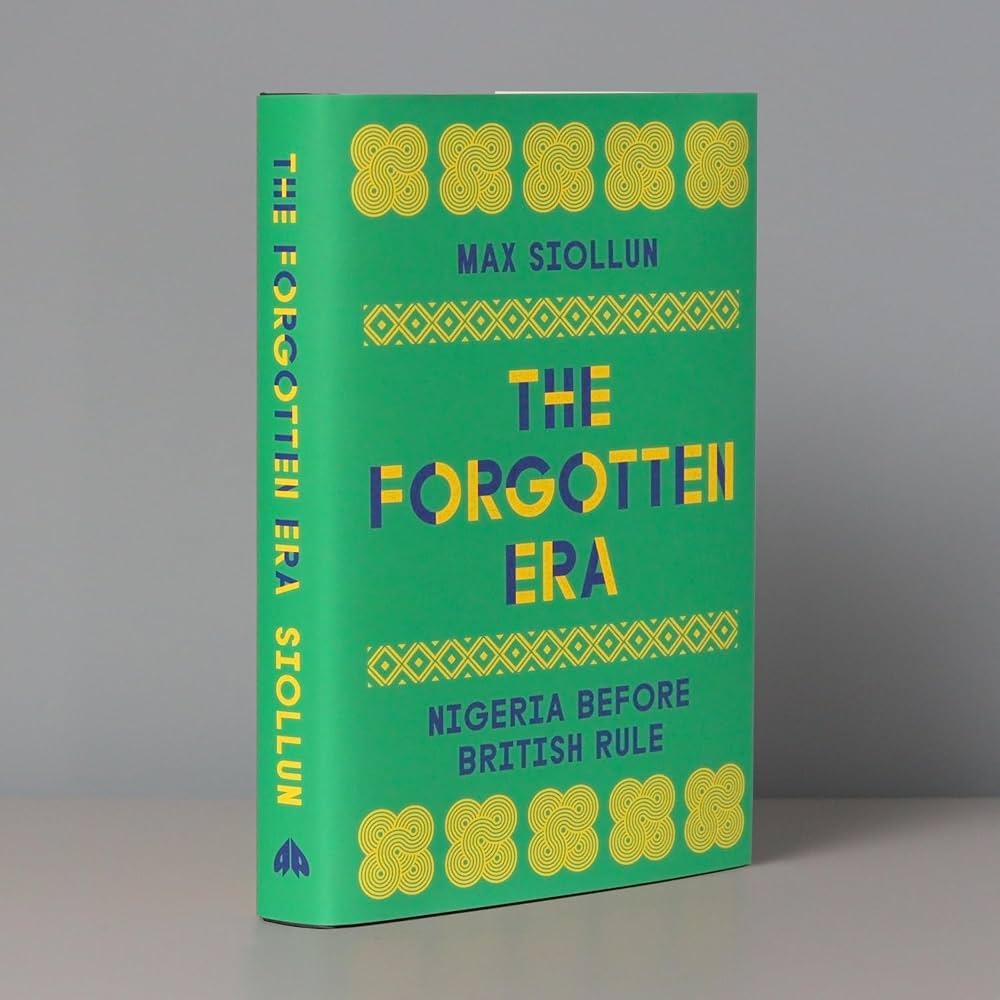
Author: Max Siollun
Top Idea: Nigeria’s history did not begin with British conquest. The societies that occupied its present territories had developed distinct political institutions, commercial networks, religious traditions, intellectual systems, and cultural achievements long before colonial rule. Understanding their experiences requires recognising their accomplishments without overlooking the conflicts, inequalities, and struggles for power that also shaped their histories.
The Big Idea
Much of Nigeria’s popular historical consciousness begins with British colonial rule, the amalgamation of 1914, the struggle for independence, or the political developments that followed independence in 1960.
These events are central to the formation of modern Nigeria, but they represent only a relatively recent period in the history of the peoples who inhabit its territories.
In The Forgotten Era: Nigeria Before British Rule, Max Siollun attempts to recover the histories of those societies before their incorporation into the British colonial state.
His argument challenges the tendency to understand African history primarily through European exploration, conquest, missionary activity, and colonial administration.
The societies that existed before colonial rule were not passive communities awaiting the introduction of political organisation or cultural development. They had established their own systems of authority, forms of economic exchange, religious institutions, intellectual traditions, and relationships with neighbouring societies.
Siollun explores this history through the emergence of the Hausa states, the development of Kanem and Borno, the religious and political transformations associated with Usman dan Fodio and the Sokoto Caliphate, the traditions of Ile Ife, the expansion and decline of Oyo, the Kingdom of Benin, and the diverse political arrangements of Igbo societies.
His account also extends beyond rulers and warfare to examine artistic production, indigenous religious traditions, writing, education, the life of Samuel Ajayi Crowther, and the contributions of women to political and intellectual life.
What emerges is a history of considerable diversity.
Different societies developed different methods of organising political authority. Some established extensive territorial states with centralised monarchies. Others relied on councils, associations, lineage institutions, and more dispersed forms of leadership.
Commercial exchange connected communities across significant distances, while religious ideas and political movements crossed boundaries that bear little resemblance to the borders of modern Nigeria.
These societies experienced periods of expansion, innovation, stability, and prosperity. They also experienced warfare, enslavement, political rivalry, and institutional decline.
Siollun’s achievement is to bring these experiences into a single accessible narrative without treating them merely as a prelude to European rule.
The book also presents a historical difficulty that deserves recognition. Nigeria did not exist as a unified political state during most of the period examined. The communities discussed had distinct political identities, and many maintained relationships extending beyond present national boundaries.
Their histories are consequently connected to Nigeria through the territories and populations eventually incorporated into the modern state, rather than through an earlier shared Nigerian nationality.
This distinction is fundamental.
The purpose of recovering these histories should not be to suggest that modern Nigeria was always destined to emerge. It should be to understand the societies that existed, how they developed, and how their experiences contributed to the historical foundations of the country.
Top Lessons
1. Political sophistication existed in different institutional forms.
One of the book’s most important contributions is its demonstration that political organisation in the territories that became Nigeria did not follow a single model.
The Hausa states developed traditions of urban administration, kingship, commerce, and political relationships among neighbouring centres.
Kanem and Borno sustained political institutions connected to regional commerce and Islamic scholarship.
Oyo developed a monarchy supported by military organisation and institutions through which influential political officeholders could restrain royal authority.
Other societies followed different paths.
Among Igbo communities, political authority often operated through councils, associations, lineage arrangements, and other institutions rather than through a single centralised monarchy. However, the experiences of individual communities differed, and Igbo political history cannot be reduced to one uniform arrangement.
These distinctions challenge the assumption that political complexity necessarily requires a powerful monarch or extensive territorial empire.
The relevant historical questions concern how authority was organised, how decisions were made, how institutions maintained order, and how political power was contested.
A society could possess elaborate political institutions without resembling the centralised states that dominate conventional historical narratives.
2. Commercial exchange and intellectual activity preceded colonial rule.
The societies examined by Siollun participated in commercial and intellectual networks that extended beyond their immediate territories.
The Hausa states were connected through regional and trans Saharan trade. Kanem and Borno maintained relationships with North Africa and the wider Islamic world.
These connections facilitated the movement of goods, people, religious ideas, and scholarly traditions.
Islamic learning was established in parts of the region before British colonial rule. Scholars produced writings on religious, legal, and political questions, while educational activity developed through institutions associated with Islamic learning.
Elsewhere, communities transmitted technical and cultural knowledge through different forms of training, apprenticeship, and social practice.
These developments do not establish that every society possessed the same educational institutions or productive capabilities.
They demonstrate that commerce, organised learning, and intellectual activity were not exclusively colonial introductions.
The historical task is to examine the forms these activities took and the evidence through which they can be reconstructed.
3. Religious transformation involved political and social struggles.
Siollun’s examination of Usman dan Fodio and the Sokoto Caliphate illustrates the importance of understanding political and religious change within its historical circumstances.
The movement associated with dan Fodio advanced a programme of Islamic reform and challenged existing political authorities.
Its emergence, however, occurred within a wider environment of disputes over taxation, political legitimacy, religious practice, and relationships among different communities.
These factors interacted during the conflicts that accompanied the establishment of the Caliphate.
The resistance of Mohammed al Kanemi in Borno is particularly significant.
His opposition demonstrates that the political and religious claims advanced by the Sokoto movement were contested by other Muslim authorities.
This complicates any account that treats the conflicts exclusively as confrontations between Muslims and non Muslims.
The broader lesson is that religious identity alone does not provide a sufficient explanation for every conflict in which religion is involved.
Political authority, economic interests, social grievances, and competing interpretations of religious legitimacy may all contribute to historical developments.
4. Institutions could restrain rulers without preventing political instability.
The political history of Oyo provides an important illustration of the relationship between authority and institutional restraint.
The Alaafin occupied a position of substantial royal authority, but he did not exercise power independently of other influential political institutions.
The Oyo Mesi, led by the Bashorun, participated in the selection of the Alaafin and exercised significant influence within the political system.
These arrangements provided mechanisms through which royal power could be constrained.
Nevertheless, the existence of institutional restraints did not eliminate political rivalry.
Competition among influential officeholders, disputes within the ruling structure, military pressures, and other conflicts contributed to periods of instability.
Oyo’s eventual decline cannot responsibly be attributed to one individual or one institutional failure. Its history involved interacting political, military, commercial, and regional pressures.
The lesson is that the existence of institutions does not establish their effectiveness under every circumstance.
Political arrangements must be examined through their actual operation, the interests of those controlling them, and the conditions under which they could sustain or undermine stability.
5. Artistic achievements provide evidence of complex cultural and technical traditions.
Siollun’s treatment of Nok, Ile Ife, Benin, and Igbo Ukwu demonstrates the importance of material culture in reconstructing African history.
The surviving terracotta, metalwork, and sculptural traditions associated with these societies reveal considerable artistic and technical achievement.
Such objects provide evidence of specialised production, established methods of craftsmanship, aesthetic traditions, and the social contexts in which artistic activity occurred.
Their significance is not confined to their beauty.
Material objects can illuminate aspects of religious belief, social organisation, political authority, and economic life that may be difficult to establish through surviving written records.
However, their interpretation also requires caution.
The existence of a sophisticated artistic object does not independently establish the precise political organisation, beliefs, or identity of the people who produced it.
Those conclusions require additional evidence.
The value of these artistic traditions lies in what they demonstrate and in the historical questions they make possible.
6. Education and intellectual achievement existed in more than one form.
The book challenges the assumption that literacy, education, and organised intellectual activity began with European missionary or colonial institutions.
Siollun examines traditions of education and writing that existed before British rule.
These included Islamic scholarship and other forms of knowledge transmission developed within different societies.
His account of Samuel Ajayi Crowther also demonstrates the important role Africans played in the development of written literature, translation, and missionary education during the nineteenth century.
Crowther was captured and enslaved during his youth before gaining his freedom and receiving an education in Sierra Leone.
He became an influential linguist, translator, and missionary. In 1864, he was consecrated as the first African bishop of the Anglican Church.
His contributions to Yoruba language scholarship and biblical translation were substantial.
Crowther’s life illustrates African participation in intellectual and religious developments that were often described primarily through European actors.
It also demonstrates why historical accounts must distinguish African initiative from the institutional circumstances within which that initiative occurred.
7. Women were important participants in political and intellectual history.
Historical narratives frequently concentrate on male rulers, military commanders, and religious leaders.
Siollun challenges this tendency by examining women whose contributions to political, intellectual, and social developments deserve greater attention.
Women exercised influence through different institutions and relationships across West African societies.
Some occupied positions of political authority. Others contributed to religious scholarship, education, commerce, or military activity.
Nana Asma’u provides an important example of women’s participation in the intellectual history of the Sokoto Caliphate.
These accounts help correct the impression that women were absent from major historical developments.
However, recognising influential women should not be confused with assuming that the societies concerned were uniformly egalitarian.
Women’s opportunities and constraints differed across communities, periods, and social positions.
The stronger historical conclusion is that the roles of women were more varied and consequential than narratives centred exclusively on male political authority often suggest.
My Notes
Recovering history without inventing a national past
What I find most important about The Forgotten Era is Siollun’s effort to recover the history of societies whose experiences are often overshadowed by colonial and modern political narratives.
There is an important difference between studying the history of Nigeria as a modern state and studying the histories of the societies that eventually became part of it.
The first necessarily gives considerable attention to colonial administration, constitutional development, independence, and subsequent political change.
The second requires a much longer historical perspective.
Siollun demonstrates why that longer perspective matters.
The inhabitants of the region possessed political institutions, commercial relationships, religious traditions, and cultural practices long before the establishment of the Nigerian state.
Yet the recovery of these histories presents a challenge.
It would be historically misleading to describe all these communities as though they possessed a common Nigerian political identity before colonial rule.
Their political loyalties, cultural relationships, and territorial arrangements were different from those of the contemporary federation.
Some maintained closer relationships with communities now located in neighbouring countries than with societies elsewhere in present Nigeria.
This does not diminish their importance to Nigerian history.
It establishes the need to distinguish historical geography from modern nationality.
I would therefore approach the book as a history of the peoples and political communities that occupied the territories of modern Nigeria, rather than as a continuous national history stretching backwards from independence.
That distinction strengthens the argument because it allows the past to be examined without making the emergence of the modern state appear inevitable.
Oral traditions and the limits of historical reconstruction
Another important issue concerns the evidence available for reconstructing early African history.
Historical knowledge depends partly on the sources that survive.
Some societies preserved extensive written traditions. Others transmitted accounts of their origins and political experiences through oral traditions.
Archaeological discoveries and material objects provide additional evidence.
Each source presents different opportunities and limitations.
Written records may reflect the interests of political authorities or religious institutions. Oral traditions can preserve important historical information while also expressing ideas about legitimacy, ancestry, and collective identity.
Archaeological evidence can establish aspects of material life without always identifying the individuals or political circumstances associated with particular objects.
The traditions surrounding Bayajidda and Oduduwa illustrate this difficulty.
These narratives are important historical evidence of how communities understood origins, authority, and relationships among ruling institutions.
However, their cultural significance does not automatically establish the literal accuracy of every event they describe.
The task of the historian is to distinguish the existence of a tradition from the historical claims contained within it.
I find this particularly important because compelling narratives can sometimes create an impression of certainty greater than the available evidence permits.
A responsible account should identify what is established, what remains contested, and what can only be reasonably inferred.
This is not a weakness of historical scholarship.
It is a necessary condition of its credibility.
Mohammed al Kanemi and the problem of whose history survives
The discussion of Mohammed al Kanemi is among the book’s most instructive contributions.
Siollun draws attention to the extent to which accounts of the Sokoto jihad were preserved through writings associated with the movement and the political order it established.
This raises a fundamental historical question.
How does the survival of particular sources influence what later generations regard as the authoritative account of events?
The writings of victorious political movements can provide invaluable evidence. However, their survival and influence do not necessarily establish that their interpretation was universally accepted.
Al Kanemi’s resistance to the expansion of the jihad into Borno reveals that competing political and religious interpretations existed.
His position challenges any account that treats the Sokoto movement’s claims to religious legitimacy as uncontested.
The significance lies in the opportunity to examine historical events through more than one perspective.
Nevertheless, an alternative account should not automatically be regarded as more reliable simply because it challenges the dominant narrative.
Both accounts require scrutiny.
The relevant questions concern the circumstances in which they were produced, the interests of their authors, and the independent evidence available to assess their claims.
The broader lesson is that historical knowledge depends not only on what happened, but also on which records survived and how those records have been interpreted.
Oyo and the meaning of institutional development
The history of Oyo is particularly valuable because it offers evidence of political institutions that constrained royal authority.
The relationship between the Alaafin and the Oyo Mesi demonstrates that authority was distributed among several influential offices.
These arrangements are historically significant.
However, I would be cautious about describing them as direct equivalents of modern constitutional government.
An institution that restrains a monarch does not necessarily provide political accountability to the wider population.
The Oyo Mesi represented an important centre of elite authority. Its ability to constrain the Alaafin did not establish that ordinary inhabitants exercised comparable influence over political decisions.
This distinction matters.
Political restraints can protect a society against arbitrary decisions by one ruler while preserving substantial privileges for another group.
They can also become instruments of political rivalry.
The historical experience of Oyo therefore demonstrates institutional complexity without establishing that its political order was necessarily inclusive by contemporary standards.
Its eventual fragmentation further illustrates why political institutions must be examined in relation to military pressures, commercial interests, provincial relationships, and changes in the distribution of power.
No single institutional feature is sufficient to explain the empire’s historical trajectory.
What I take from Oyo’s experience is an appreciation of the different ways political authority can be organised, alongside a recognition that institutional design must be assessed through its practical consequences.
Cultural achievement should not obscure coercion and inequality.
One of the risks associated with recovering neglected history is that a necessary correction can become an exaggerated celebration.
For generations, African societies were frequently represented in colonial accounts through assumptions about their supposed inferiority.
The correction of these representations is important.
Yet the appropriate response is not to portray precolonial societies as though they were free from violence, exploitation, or political injustice.
The histories of Oyo, Benin, the Hausa states, and other societies include warfare, slavery, struggles for political authority, and unequal social relationships.
These experiences are part of the historical record.
A society could develop sophisticated artistic traditions while participating in systems of enslavement.
A political institution could possess elaborate procedures while concentrating authority among privileged groups.
A commercial network could support economic activity while involving forms of coercion.
Recognising these contradictions does not diminish the achievements of the societies concerned.
It allows those achievements to be understood within a more complete account of their historical circumstances.
I would have liked the relationship between political power, commerce, slavery, and the experiences of ordinary people to receive sustained attention alongside the accounts of rulers and major political developments.
This is particularly important because the histories of communities cannot be fully understood through the actions of their political elites alone.
Farmers, artisans, traders, enslaved people, and other inhabitants participated in the economic and social systems that sustained these societies.
Their experiences should form part of the explanation.
Recovering religious and intellectual history
I find the book’s treatment of indigenous religion, writing, and education especially important.
Historical discussion of religion in Nigeria frequently concentrates on Christianity and Islam.
These traditions have profoundly influenced the development of the country.
However, the religious history of its peoples extends beyond them.
Indigenous religious institutions shaped ideas about authority, social obligations, ritual practice, and relationships between communities and the spiritual world.
These traditions deserve historical investigation without relying on dismissive descriptions.
Understanding a religious system does not require accepting its metaphysical claims. It requires examining what its adherents believed and how those beliefs shaped social practice.
The same principle applies to systems of education and knowledge transmission.
Modern educational institutions should not be treated as the only legitimate forms of learning.
Communities developed ways of transmitting technical knowledge, religious instruction, artistic skills, and social responsibilities before the introduction of colonial schools.
At the same time, different educational traditions should not be treated as identical.
Their organisation, accessibility, purposes, and intellectual content varied.
A careful historical account should preserve those distinctions rather than replacing one assumption of inferiority with another assumption of equivalence.
History can inform contemporary Nigeria without determining its future.
Siollun’s concluding discussion draws connections between precolonial political diversity and the contemporary Nigerian state.
These connections are worth examining.
The territories that became Nigeria were not historically uniform. Their societies differed in language, religion, political structure, and economic organisation.
However, diversity did not prevent the formation of states, commercial networks, or relationships among different communities.
This observation challenges simplistic claims that diversity alone makes political organisation impossible.
Nevertheless, it does not establish that historical examples provide direct solutions to modern constitutional questions.
Precolonial states operated under circumstances substantially different from those of contemporary Nigeria.
They did not possess the same conceptions of citizenship, public administration, electoral representation, or national government obligations.
Consequently, historical experience should inform rather than determine contemporary constitutional design.
Questions concerning federalism, decentralisation, fiscal responsibilities, minority protections, and the distribution of political authority require evidence about present institutional conditions.
Historical comparison may identify useful possibilities or expose unsupported assumptions.
It cannot replace the assessment of whether a particular institutional arrangement would function effectively today.
What the book added to my understanding
The most important contribution I take from The Forgotten Era is a fuller appreciation of the historical depth and diversity of the societies that eventually became Nigeria.
It is possible to be familiar with Nigeria’s colonial and independence history while possessing an incomplete understanding of the political and cultural worlds that existed before those events.
Siollun demonstrates that these earlier histories deserve attention in their own right.
The book also changes how I would approach historical evidence.
I would be more cautious about treating a familiar narrative as an established fact merely because it has been repeated for generations.
The distinction between oral tradition, written testimony, archaeological evidence, and historical interpretation becomes especially important when reconstructing periods for which evidence is incomplete.
A third lesson concerns political institutions.
The existence of complex arrangements for distributing authority does not necessarily establish broad political participation, stability, or fairness.
Institutions must be examined through the interests they served, the relationships they regulated, and the consequences of their operation.
Finally, the book reinforces the importance of treating historical achievement and historical injustice as compatible subjects of investigation.
Recognising the achievements of precolonial societies should not require minimising slavery, warfare, inequality, or coercion.
A serious understanding of the past must accommodate both.
The central shift in my understanding is therefore methodological as much as historical.
Rather than beginning with the colonial encounter and looking backwards only to identify what preceded it, I would begin by asking how these societies developed, what their institutions accomplished, what conflicts they experienced, and how the surviving evidence allows us to understand them.
That is the enduring intellectual contribution I find in Siollun’s work.
Key Takeaways for the Nigerian Condition
1. Nigeria needs a broader understanding of its historical foundations.
Public knowledge of Nigerian history should extend beyond colonial conquest, amalgamation, independence, and subsequent political developments.
The histories of the societies that preceded the modern state deserve systematic attention.
This includes their political institutions, economic relationships, religious traditions, intellectual achievements, cultural practices, and conflicts.
Such knowledge would provide a more complete account of the historical experiences that contributed to the formation of modern Nigeria.
2. Historical education should distinguish evidence from tradition.
Nigeria’s historical narratives include oral traditions, written records, archaeological discoveries, and interpretations developed by historians.
These sources should be approached according to their evidentiary characteristics.
Historical education should help students distinguish established events from contested interpretations and culturally significant origin narratives.
The objective should not be to diminish oral traditions.
It should be to understand their historical importance while recognising the limits of what they independently establish.
3. Cultural heritage requires systematic preservation.
The archaeological remains, manuscripts, historical buildings, artistic objects, and oral traditions associated with Nigeria’s past are important sources of knowledge.
Their preservation requires documentation, professional conservation, appropriate research facilities, and engagement with communities connected to the materials.
The historical significance of cultural objects should not be reduced to their commercial value or their usefulness in public celebrations.
They provide evidence through which the country’s past can be investigated and understood.
4. Historical institutions should be studied within their original circumstances.
The political arrangements of Oyo, Benin, the Hausa states, and other societies provide valuable evidence of different approaches to political authority.
However, these arrangements should not be presented as direct equivalents of modern democratic or constitutional institutions.
The relevant questions concern who exercised authority, how power was constrained, whose interests were represented, and how decisions affected society.
Historical understanding becomes stronger when institutions are assessed within the circumstances in which they operated.
5. Nigeria’s diversity should be understood historically.
The communities that eventually became part of Nigeria possessed different languages, religions, political arrangements, and social traditions.
Many also maintained extensive relationships with neighbouring societies.
Understanding this history is important for appreciating the complexity of the modern federation.
However, historical diversity should not be treated as either an automatic obstacle to political unity or evidence that political cooperation will necessarily succeed.
The consequences of diversity depend on institutional arrangements, political relationships, and the circumstances in which communities interact.
6. Historical narratives should include the experiences of ordinary people.
The history of political leaders and major institutions is important, but it is insufficient.
Farmers, traders, artisans, women, migrants, enslaved people, and other social groups contributed to the economic and cultural development of precolonial societies.
Their experiences provide evidence about production, exchange, inequality, social organisation, and everyday life.
A more complete history of Nigeria should therefore examine society beyond the actions of rulers and military leaders.
7. Contemporary policy should be informed by history without being dictated by it.
Historical evidence can illuminate how institutions developed, how authority was distributed, and how communities responded to political and economic change.
These insights may contribute to contemporary discussions about governance and national development.
However, historical precedent does not establish that a particular policy will work under present conditions.
Modern institutional proposals require independent assessment of their feasibility, costs, consequences, and effects on different populations.
The responsible use of history is to improve understanding and identify relevant questions, not to substitute historical analogy for contemporary evidence.
My Final Assessment
Max Siollun’s The Forgotten Era: Nigeria Before British Rule provides an accessible account of the political, cultural, intellectual, and social histories of societies that existed before the establishment of modern Nigeria.
Its principal contribution lies in directing historical attention towards African communities as actors in their own development rather than treating their experiences primarily as background to European intervention.
Through its examination of the Hausa states, Kanem and Borno, the Sokoto Caliphate, Oyo, Benin, Igbo societies, and other historical subjects, the book demonstrates the diversity of political institutions and social arrangements that existed across the region.
Its attention to artistic production, religion, education, and women broadens the account beyond the history of rulers and warfare.
The book is particularly useful where it introduces neglected historical actors and demonstrates the importance of examining competing accounts of major political and religious developments.
Nevertheless, its geographical and chronological breadth creates limitations.
The available evidence is uneven across the societies and periods examined. Some historical narratives depend on oral traditions or interpretations that remain contested. The relationships between political authority, slavery, commerce, and the experiences of ordinary people also warrant sustained examination.
These limitations are important because an accessible historical narrative should not create an impression of certainty beyond what the evidence permits.
I would also distinguish the book’s historical contribution from the contemporary political implications that might be drawn from it.
Precolonial experiences can deepen our understanding of Nigeria’s institutional and cultural history, but they do not independently establish which political arrangements would best serve the modern state.
The book is therefore most valuable as an invitation to historical understanding rather than as a definitive explanation of contemporary Nigerian problems.
For readers interested in Nigerian history, African societies, political institutions, and cultural heritage, it provides a substantial starting point for further inquiry.
The most important lesson I take from The Forgotten Era is that understanding Nigeria requires knowledge of the societies that preceded its formation, examined through evidence rather than inherited stereotypes or romanticised accounts of the past.
Their political institutions were diverse. Their intellectual and cultural achievements were significant. Their histories also included conflict, coercion, and inequality.
Understanding these dimensions together makes it possible to appreciate their experiences without distorting them.
That is the value of Siollun’s book. It restores historical attention to societies whose stories deserve to be understood on their own terms.
Keep the conversation open.
Essays, reading notes and public commentary on food, households, markets, institutions, public service and leadership.
Subscribe to receive new essaysExplore more writing