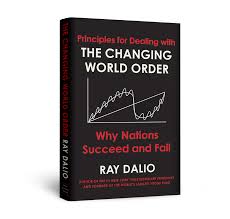
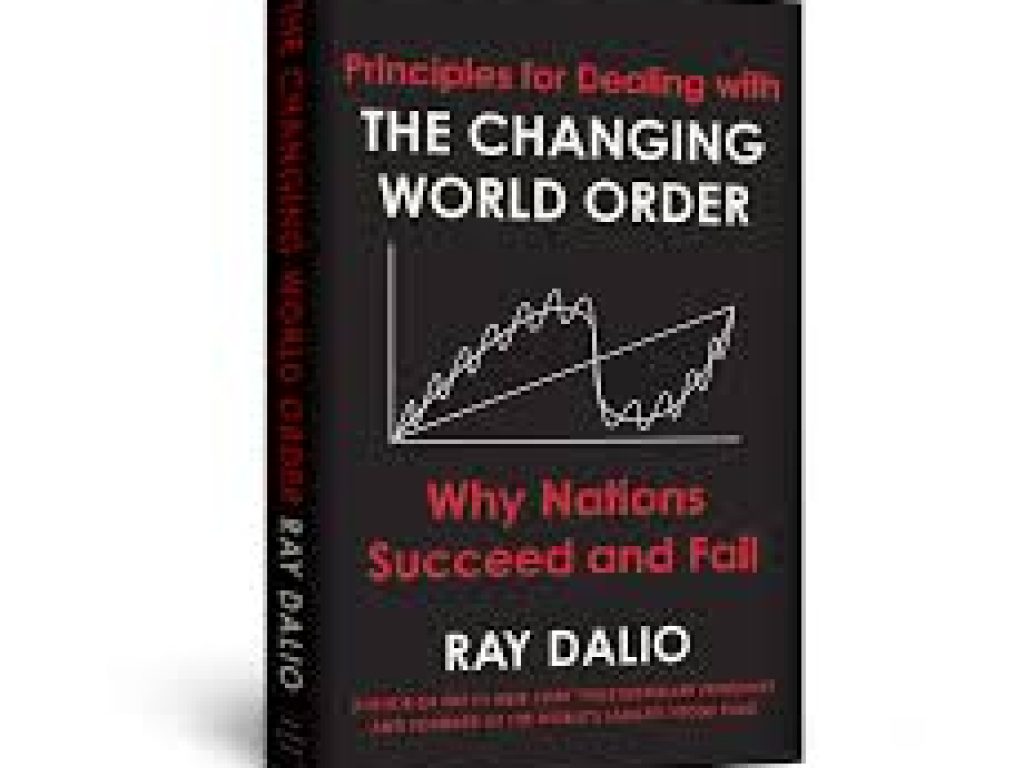
Principles, The Changing World Order
Author: Ray Dalio
Top Idea: No world order is permanent. Prosperity is a cycle driven by a Big Cycle of repeatable structural forces; debt, internal cohesion, and productivity. Survival depends on recognizing where you are in that cycle and prioritizing internal discipline over the illusion of permanent dominance.
The Big Idea
Ray Dalio argues that history is not a series of random events but a predictable sequence of rises and declines. By analyzing the last 500 years of history, he identifies the Big Cycle that governs empires (the Dutch, British, and Americans). The core message is that internal health determines external power. When a nation’s debt grows too large, its wealth gap becomes too wide, and its internal politics become too polarized, the order inevitably shifts toward a new challenger.
Top Lessons
- Empires rise through high productivity and innovation, peak through financialization and over-extension, and decline through debt crises and internal conflict.
- Orders usually collapse from the inside out. Extreme inequality and polarization paralyze a state’s ability to solve problems, making it vulnerable to external rivals.
- Success breeds over-borrowing. Eventually, the cost of maintaining an empire exceeds its income, leading to currency debasement and a loss of reserve status.
- No amount of clever monetary policy or military posturing can compensate for a decline in real-sector output and educational excellence.
My Notes
1. The Anatomy of the Rise and Fall
- Dalio tracks power through a specific set of metrics: education, innovation/technology, cost-competitiveness, economic output, share of world trade, military strength, financial center strength, and reserve currency status.
- Prosperity leads to higher labour costs (reducing competitiveness) and encourages a shift from work and investment to consumption and leisure, often funded by debt.
- For developing nations like Nigeria, the risk is entering the decline phase (debt and institutional weakness) before ever reaching the peak of productivity and broad-based wealth.
2. Money, Debt, and Trust
- A stable currency is a sign of a disciplined state. When trust is abused via unchecked borrowing or inflation, the currency reflects the deeper dysfunction of the governance model.
- Late-stage empires almost always print money to pay off debts, which devalues the currency and leads to a flight from that nation’s assets.
- Chronic inflation and exchange rate volatility are symptoms of a weak real-sector foundation. As Dalio notes, no monetary reform can compensate for weak real-sector foundations.
3. The Breaking Point: Internal Order
- When the “haves” and “have-nots” lose a shared sense of fairness, the system breaks. This leads to populism on both the left and right, making compromise impossible.
- For Nigeria, internal fragmentation (ethnic, regional, and class-based) is the ultimate order-killer. If a society cannot mobilize collectively, it cannot compete globally.
- This is the final stage of the decline cycle, where internal tensions explode into a reordering of the system, often violently.
4. Leadership and the Burden of Choice
- Effective leaders recognize where their country sits in the cycle. They don’t fight the Big Cycle with denial; they adapt by building resilience.
- The window for making constructive choices (reducing debt, closing wealth gaps) is always smaller than it appears. Delaying these choices only makes the eventual reordering more painful.
Key Takeaways for the Nigerian Condition
- Nigeria must avoid copying late-stage Western models of high debt and consumption. The focus must remain on the early-stage drivers of power: Education and Productivity.
- Our identity crisis is an economic threat. Without internal cohesion, the state cannot protect its interests or leverage its demographic size.
- A youthful population is only an asset if it is productive. Without a foundation of real-sector growth, demographic size becomes a liability in the Internal Conflict phase of the cycle.
- To matter in the next world order, Nigeria must build reserve trust. Institutions that are seen as fair and disciplined enough to survive global shifts.
Notable Quotes
- Systems decay when leaders mistake temporary advantage for permanent right.
- The window for constructive choice is always narrower than it appears.
- Orders collapse not because problems exist, but because societies lose the capacity to confront them together.