
Hunger is the most primal signal of state failure. Long before currency devalues or borders become porous, the inability of a population to feed itself signals a rupture in the social contract. In Nigeria, we are witnessing a transition from episodic food shortages to a structural crisis of malnutrition that threatens the very viability of the Nigerian state.
The narrative surrounding Nigerian agriculture has been one of potential. Focus has been on the vast arable lands, the resilient peasantry, and the promise of self-sufficiency. However, this optimism obscures a darker reality. Food insecurity in Nigeria has metastasized from into a kinetic security threat. When we speak of hunger at the crossroads, we are discussing both the caloric deficits and the erosion of the state’s legitimacy.
State fragility is often defined by the presence of armed conflict or the collapse of institutions. Yet, in this context, fragility is better understood as institutional entropy. It is the gradual decline of the state’s capacity to mediate resource distribution and enforce the rule of law in the agrarian sector. When the state cannot guarantee the safety of a farmer in the Middle Belt, or the affordability of grain in a Lagos market, it has effectively ceded its sovereignty to non-state actors, market cartels, probability and chaos.
The current hunger crisis is the result of a specific governance architecture that has deprioritized food systems as a matter of national security. We are witnessing the breakdown of three critical governance pillars: policy coherence, institutional capacity, and political will.
To understand the crisis, we must move beyond the superficial metrics of inflation and look at the machinery of the Nigerian state. The persistence of hunger is about the friction within the systems that produce and distribute it.
The Political Economy of Neglect
Nigeria’s approach to food security has historically been reactive rather than structural. We see a cycle of interventionism. Fertilizer subsidies, anchor borrower schemes, and emergency grain releases that treat the symptoms rather than the disease. These interventions are often captured by political patronage networks, turning agricultural support into a mechanism for rent-seeking rather than productivity.
The resource curse is typically associated with oil, but it applies equally to our neglect of the agrarian economy. Because the Nigerian state derives its fiscal survival from crude oil rents rather than the taxation of a productive agricultural base, it has little incentive to build the complex infrastructure required for a modern food system. The farmer is not seen as a constituent to be served, but as a relic to be managed. This disconnect creates a policy vacuum where specialized agencies operate in silos, disconnected from the realities of rural logistics, storage, and security.
The Anatomy of Price Divergence
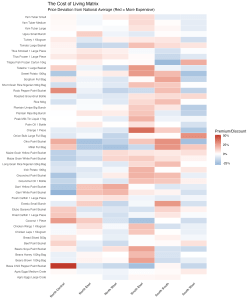
The breakdown of the Nigerian state is most visible in the pricing mechanisms of its internal trade. Standard market theory suggests that rural farm gate prices and urban retail prices should converge, separated only by the marginal cost of transport and a reasonable profit margin. In Nigeria, however, this transmission mechanism has collapsed. Current data from the National Bureau of Statistics (NBS) and the Nigeria Food Security Project, when subjected to spatial analysis, reveals a divergence that cannot be explained by inflation alone.
We are witnessing a phenomenon I term Logistical Apartheid. A crate of tomatoes leaving a farm in Kano or a basket of tubers from Benue undergoes a price metamorphosis that defies economic logic before reaching Lagos. This is not about the cost of diesel. It is about the logistical friction of moving food supplies from one point to the other.
From a GIS perspective, if we map the major food corridors, the Lagos-Kano or the Onitsha-Benue axes, we see hotspots of extortion that act as artificial tariff barriers. The lack of a functional rail system means 90% of food moves by road, exposing it to a gauntlet of state and non-state actors. Between a farm in the Middle Belt and a market in the South West, a truck may encounter up to fifty checkpoints. At each point, a tax is levied. Not by the Nigeria Revenue Service (NRS), but by police, army, customs, and vigilante groups.
This is where spatial inequality deepens. The friction of distance in Nigeria is weaponized. A farmer in a remote, bandit-prone LGA is forced to sell at a loss due to a lack of safe access to aggregators, while the urban consumer pays a premium for the security rent added to every kilogram of grain. The price gap is, effectively, the cost of the state’s absence.
The Middlemen as Political Sovereigns
To fully understand why food prices remain sticky downwards even when harvest yields improve, we must interrogate the role of the aggregators. The market unions, transport associations (like the NURTW and RTEAN), and commodity cabals. In the vacuum of effective state regulation, these groups have evolved from ordinary traders into formidable political actors who control the calorie flow of the nation.
These unions operate as a shadow government. They facilitate trade and govern it. Through a complex system of levies, gate fees, and territorial monopolies, they determine who sells, where they sell, and at what price. In many Lagos markets, for instance, the barrier to entry for a new food merchant is not capital, but permission from the market union Iyaloja or Babalaje.
This is Food Politicking. And it is real. These actors possess the power to strangle urban centres by choking supply, a tactic effectively used as leverage during political negotiations. They are critical nodes in the patronage network of Nigerian politics. Keeping them happy often takes precedence over keeping food affordable. And by ceding the management of food logistics to these cartels, the Nigerian state has privatized one of its most critical security functions. We are dealing with supply and demand; as much as we are dealing with a cartelized political economy where hunger is a negotiated outcome.
The Security-Agriculture Nexus
We cannot discuss food production without discussing the monopoly on violence. The abandonment of the rural hinterlands to banditry and insurgency is the single greatest driver of food inflation today. When the state retreats from the forests of the North West or the highways of the South, it imposes a fear tax on every kilogram of food produced.
Farmers in Benue or Taraba have to add the fear of extermination to the risks of weather. This forced displacement creates a vicious feedback loop: insecurity reduces harvest yields, low yields drive up prices, high prices fuel social grievances, and grievances fuel further insecurity. The state’s inability to secure its agrarian belts is a direct admission of limited state capacity.
In urban centres, this governance failure manifests as volatility. The Nigerian city is powered by the informal economy of survival. When food prices breach the threshold of affordability, the urban poor are pushed from resilience into resistance. The correlation between food inflation spikes and civil unrest is undeniable. Hunger strips away the patience required for democratic process. It creates a volatile citizenry for whom the state is an adversary.
A Comparative Lens
Nigeria is not unique in its challenges, but it is unique in its underperformance relative to its resources. When we examine other African nations, we can identify divergent paths: those that have built resilience through state capacity, and those that have crumbled under similar pressures.
Ethiopia vs. Nigeria
The divergence between Nigerian and Ethiopian food security strategies is a case study in analog vs. digital governance. Despite its own struggles with conflict and fragility, Ethiopia offers a compelling counter-narrative through its Productive Safety Net Programme (PSNP). Recognizing that chronic food insecurity was a driver of regime instability, the Ethiopian state institutionalized a massive social protection system.
The PSNP is a mechanism of state capacity. It utilizes a sophisticated biometric registry to ensure that aid reaches specific, verified households. Payments are increasingly digitized, moving directly from the treasury to the beneficiary’s mobile wallet or smart card. This bypasses the layers of bureaucracy where corruption typically thrives. Crucially, the PSNP links these transfers to labour. Beneficiaries build rural roads, terraces, and water harvesting structures, thereby creating the very infrastructure needed to prevent future famines.
Contrast this with the Nigerian experience of the Social Register. Despite billions spent, the database remains opaque, contested, and often disconnected from the realities of the rural poor. When Nigeria attempts cash transfers, the physical movement of cash often leads to stampedes or theft. Ethiopia proves that in the 21st century, you cannot fight hunger with Ghana-must-go bags of cash. You fight it with data, biometrics, and digital trails. The lesson here is clear. Logistics is governance.
The State as Agrarian Manager
Rwanda presents a model of authoritarian developmentalism in agriculture. Through the Strategic Plan for the Transformation of Agriculture (PSTA), the Rwandan state integrated land consolidation, crop intensification, and market access into a single, tightly managed command chain.
While the political context differs, the administrative lesson for Nigeria is the power of data and accountability. In Rwanda, local officials are evaluated on nutritional metrics and harvest yields. In Nigeria, the disconnect between federal ministry directives and local government implementation is absolute. Rwanda teaches us that without a transmission mechanism for policy, high-level strategies are mere hallucinations.
Sudan
Conversely, Sudan serves as a grim warning. The collapse of the Bashir regime and the subsequent descent into civil war were preceded by an acute bread crisis. The state’s inability to maintain wheat subsidies, coupled with the loss of oil revenue, created a legitimacy vacuum that warlords filled. Sudan illustrates that when a state fails to feed its people, it creates an opening for non-state actors to weaponize hunger, eventually consuming the state itself.
The Doctrine of Food Sovereignty
If we accept that hunger is a governance crisis, then the solution must be political and structural.
1. The Securitization of Food Systems
Nigeria must designate its food supply chain as Critical National Infrastructure (CNI). Just as we deploy military assets to protect oil pipelines, we must deploy specialized security assets to protect the green corridors, the key logistical routes moving food from the North to the South. This requires a fusion of the Ministries of Agriculture, Environment and the Ministry of Interior. We need a Food Security Task Force that is not just about distributing grain, but about securing the territory where grain is grown.
2. A Template for Regional Sovereignty
We must stop waiting for Abuja to solve a problem that is fundamentally local. The Federal Government cannot farm the land. The solution lies in the sub-national units. The South-West offers a viable template for regional food sovereignty through the logic of the DAWN Commission (Development Agenda for Western Nigeria). The region possesses the Oyo-Osun-Ogun agrarian corridor, which has the potential to be the breadbasket of the entire West African coast.
The strategic implication here is Regional Integration as Food Security. The Governors of the South-West must activate a specialized trade protocol. This would involve:
- Amotekun Agro-Rangers: A dedicated unit of the regional security network specifically tasked with securing the Green Corridors and farm clusters in Oke-Ogun and Ekiti, protecting farmers from the banditry that plagues the centre. This is quite different from general policing as it is specialized economic protection.
- The Fashola-Agribusiness Hub Model: Replicating the success of dedicated agro-industrial zones that cluster processing, storage, and power in one location. This reduces post-harvest losses, which currently claim 40% of yield by bringing the industry to the farm gate.
- Commodity Exchange Integration: A unified South-West commodity board that guarantees off-take for farmers in Osun to feed the insatiable demand of Lagos, bypassing the extractive checkpoints of the federal highways.
When we treat the South-West as a single economic bloc, we can create a buffer zone of food stability that insulates the region from the volatility of the national macro-economy. State Governors must be ranked on a Food Security Index, making them politically liable for the nutritional status of their constituents.
3. Data as the New Fertilizer
We cannot manage what we do not measure. The current reliance on outdated or fragmented data leads to blind policy. We need a real-time, GIS-enabled National Food Systems Dashboard. This system should track price variances, rainfall patterns, insecurity incidents, and logistics bottlenecks in real-time. This is where econometrics meets governance. We must apply rigorous data analysis (Difference-in-Differences models to test policy interventions), in order to stop guessing and start engineering solutions.
The Architecture of Survival
We are at the crossroads. One path is the business as usual approach: sporadic interventions, reliance on imports, and the gradual erosion of state authority until hunger sparks a conflagration the security forces cannot contain. This is the path of state failure.
The other path is the Architecture of Survival. It requires a reimagining of the Nigerian state as a steward of the land and people. It demands that we view the child suffering from stunting in Borno and the underemployed youth in Lagos as victims of the same governance failure.
Addressing hunger is the ultimate test of state capacity. If we can solve the logistics of food, we can solve the logistics of healthcare, education, and industrialization. The systems required to secure a harvest are the same systems required to secure a nation.
Nigeria must choose. We can either build a state capable of feeding its people, or we will watch the people consume the state. The time for agrarian rhetoric is over; the time for governance engineering has begun.